What My Grandmother's Unfinished Sweater Taught Me
My grandmother died in March, and in April my mother handed me a grocery bag with a half-finished cardigan inside it, needles still through the live stitches of a sleeve that stopped two inches short of a cuff. "You're the one who knits," she said, which was true, and also not really an explanation for why she was giving it to me rather than keeping it herself. I think we both understood that neither of us knew what you're supposed to do with an unfinished thing someone leaves behind.
The sweater that wasn't mine to finish
For the first few months I didn't touch it. It sat in the bag on a shelf, and every time I saw it I had the same impulse — just finish the sleeve, block the whole thing, give it a life — immediately followed by the same hesitation. It wasn't my sweater. It wasn't my gauge, my yarn choice, my decision about where the waist shaping should sit. Finishing it felt less like completing her project and more like overwriting it with mine, the way it feels wrong to finish someone else's sentence even when you're fairly sure what they were going to say.
What her tension told me
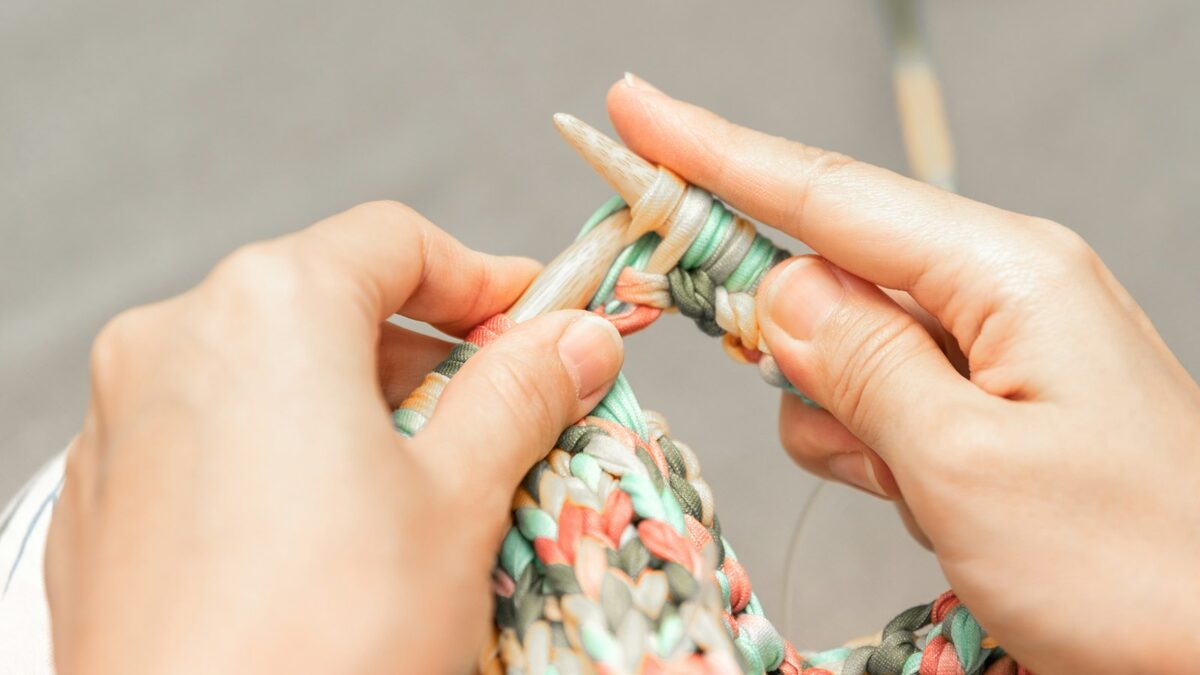
Eventually I did pick it up, mostly to understand it rather than to finish it. Her stitches were tighter than mine — noticeably so, maybe a full needle size tighter by feel, which matched everything I remembered about how she held things, how she gripped a steering wheel or a pen. I'd never thought about tension as a kind of handwriting before. Looking at that sleeve, I could tell it was hers the way you can tell a letter is from someone specific before you've read a word of it, just from the shape of the first line.
The decision she'd already made, two inches before the end
About four inches from the cuff, there's a small, deliberate change — she'd switched from a plain stockinette sleeve to a narrow band of moss stitch, clearly planning to carry it down into a textured cuff rather than a plain ribbed one. It's not in any pattern I could find; it's a choice she made herself, mid-row, that the pattern didn't ask for. I sat with that for a long time. She wasn't just executing someone else's instructions. She was making a sweater that was specifically, only, going to be hers, right up until the moment she had to put the needles down for the last time and never picked them back up.
Why I stopped trying to finish it
I tried, once, to work out her gauge precisely enough to continue in a way that would look seamless — matching needle size, matching tension as closely as I could fake it, so that a stranger looking at the finished sweater wouldn't be able to tell where her two inches ended and my two inches began. I got about six rows in and ripped them back out. It wasn't that I couldn't match her tension closely enough. It was that matching it felt like erasing the fact that this sweater has two knitters in it, one of whom isn't here anymore to approve of what the other one decided to do with her unfinished moss-stitch cuff.
What I did instead
I finished the sleeve in a deliberately different yarn — same weight, same needle size, but a color that doesn't try to match, so the join is visible rather than hidden. I kept her moss-stitch decision and extended it the way I think she was heading, but I didn't pretend the last two inches came from her hands instead of mine. The cardigan has a visible seam in it now, a line where one knitter's work stops and another's starts, and it's the thing about it I'd least want to change.
What it taught me about my own unfinished things
- Not every project needs to be finished by the person who started it, but it shouldn't pretend it was, either.
- Tension really is a kind of handwriting, and it's worth paying attention to your own — someone, someday, might be looking at it the way I looked at hers.
- A deliberate, visible seam between two different hands is more honest, and often more interesting, than a seamless one that erases the fact that something changed.
- I no longer feel obligated to finish every project I start in the order or timeline I originally imagined. Some things are allowed to sit in a bag for a while before you know what you actually want to do with them.
The cardigan hangs in my closet now, worn, not as a memorial piece kept in tissue paper, but as a sweater I actually wear in October. Every time I put it on, my hand finds that seam near the left cuff without meaning to. I don't think I'll ever stop noticing it, and I've stopped wanting to.
What my mother said when she saw it finished
I brought it to her the next time I visited, half-expecting her to be upset that I'd changed the yarn instead of matching it invisibly. She held the cuff for a long time without saying anything, running her thumb over the join the way I do now without noticing. Then she said something I hadn't expected: that the sweater looked more like her mother, finished that way, than it would have if I'd hidden the seam — because her mother was never someone who smoothed over a change once she'd made it. If she'd decided halfway through a row that she didn't like a choice, she ripped back and said so, out loud, usually while someone else in the room was trying to watch television. A visible seam, it turned out, wasn't a departure from her way of doing things. It was closer to a tribute than anything I could have knitted on purpose.
What I'd tell someone handed the same grocery bag
Don't finish it right away, and don't feel obligated to finish it at all. Sit with it first — look at the tension, notice the small decisions, the places where a pattern was clearly abandoned in favor of something more personal. Those details are the actual inheritance; the finished object is almost secondary to them. When you do decide to pick up the needles again, whether that's two months later or three years later the way it was for me, let the join show. An invisible seam erases the one thing that makes an unfinished project worth finishing at all: the fact that it passed through more than one pair of hands on its way to being whole.